Tired feet and sore arches at the end of the day? The best shoes for flat feet combine arch support, a firm midsole, a stable heel and room for your toes. Pick for comfort, not looks.
If you want the wider picture on fit and shoe categories, our footwear buying guide is a good next stop.
| Item | Value |
|---|---|
| Shoe type often suggested for flat feet | Stability shoes with structured arch support |
| Midsole feel | Firm |
| Minimum insole heel cup depth | 14 mm (18-20 mm for significant hindfoot valgus) |
| Insole shell hardness for symptomatic flat foot | Shore A 50-60+ |
| Plantar pressure reduction, over-the-counter arch support | 15-25% |
| Plantar pressure reduction, custom orthotic | 25-40% |
These figures come from CLS Health’s arch-type guide and Michigan Foot Doctors’ arch-support guide. Clinic-published figures can change, so check the source before you rely on them.
What flat feet mean for your shoe choice
With a flat foot, the arch has dropped. In the words of Parkview Health’s podiatry blog, the midfoot collapses and the entire bottom of the foot touches the ground.
That does not automatically mean pain. CLS Health notes that flat feet don’t always cause problems, and Michigan Foot Doctors describes flat feet as a structural variant that runs from completely asymptomatic to severely painful.
Two terms help when you read shoe descriptions. Flat feet may be flexible, where an arch appears when you are not standing, or rigid, where the arch stays flattened, and they may go with overpronation, when the foot rolls inward excessively during walking (CLS Health).
Shoe features that matter most
Podiatry sources agree on a short checklist. Parkview Health advises choosing shoes with arch support, a firm midsole and cushioning, and CLS Health adds toe room and heel stability.
- Arch support: supports the midfoot and may improve comfort, especially when flat feet cause symptoms.
- Firm midsole: helps limit excessive foot motion without making the shoe uncomfortably rigid.
- Heel stability: a supportive heel counter may help improve rearfoot stability.
- Wide toe box: gives toes space to move and reduces pressure on bunions or other sensitive areas.
- Cushioning: helps absorb impact during walking or prolonged standing.
A simple in-store check follows from this: the shoe should hold your foot without letting it collapse inward. CLS Health lists a comfortable fit that does not collapse inward among the features to look for.
Comfort should win over style. Parkview Health points out that supportive shoes aren’t always the most stylish, and it is important to prioritize comfort over fashion.
Stability, motion-control or walking shoes
Stability shoes are the usual starting point. Michigan Foot Doctors describes them as having a medial post (denser foam on the inner midsole), a semi-curved last and a firm heel counter, and calls this the appropriate category for most flat foot patients.
Motion-control shoes go further, with a straight last, maximum medial post density and a very rigid heel counter. The trade-off is a stiffer, less flexible shoe that may be uncomfortable if you don’t need that level of control (Michigan Foot Doctors).
The same clinic says to avoid these types, because they allow unrestricted pronation:
- Neutral shoes with no medial support
- Minimalist or zero-drop shoes
- Fashion shoes with flexible soles
As neutral examples only, not endorsements, CLS Health lists the Brooks Adrenaline GTS, New Balance 860 and ASICS Gel-Kayano as stability examples. For walkers, CLS Health describes the Brooks Addiction Walker 2 as a supportive walking shoe designed for everyday use.
Walking and running shoes can both work. Walking shoes may suit everyday activities better, while stability-oriented running shoes may suit exercise, so match the shoe to your use. Our guide on how to choose walking shoes goes through the everyday-wear side in more detail.
Check your arch and fit at home
A wet footprint gives you a quick starting point. CLS Health describes the test in four steps:
- Fill a shallow pan with water.
- Wet the bottom of your foot.
- Step onto a piece of cardboard or a paper bag.
- Step away and look at the footprint.
With flat feet, almost the entire foot leaves a print with little to no curve. The test is only a starting point, so a podiatrist should confirm your arch type and walking pattern.
Fit matters as much as arch support. Our steps on how to measure foot size at home help you buy the right length and width, and CLS Health warns that very flexible, poorly fitting or worn-out footwear may aggravate symptoms in some people.
Do you need insoles or orthotics?
Not always. CLS Health says not everyone with flat feet needs special shoes or orthotics, while its arch-type guide says some people may also benefit from arch-support inserts or custom orthotics, depending on symptoms, activity level and walking pattern.
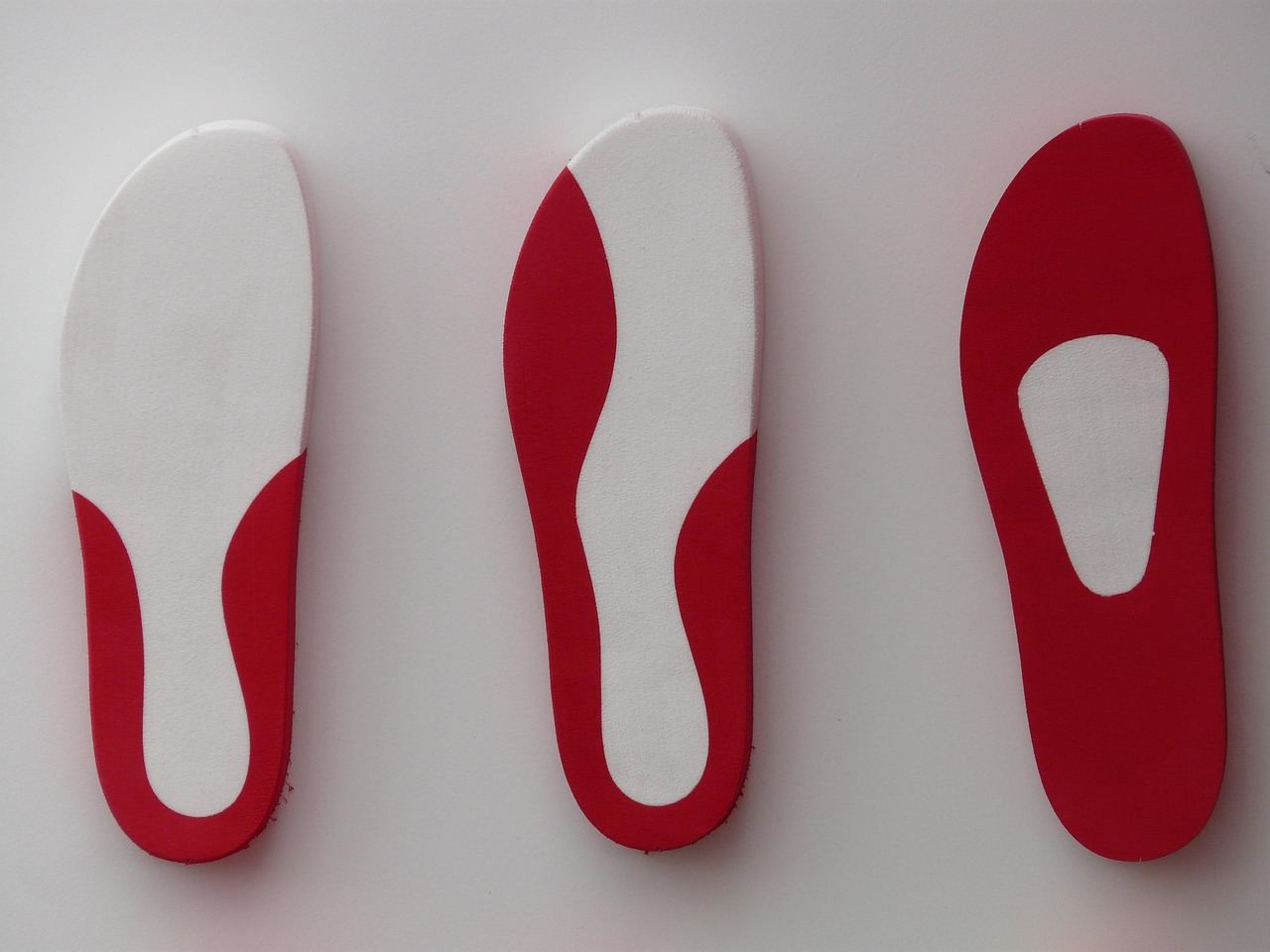
If you buy an off-the-shelf insole, Parkview Health says to stick to a stiff insole that doesn’t bend or fold. If it does bend, it should only bend where your toes fold naturally.
Michigan Foot Doctors gives more detail on what to look for in an over-the-counter arch support:
- A semi-rigid to rigid shell, not a soft foam insert.
- Shore A hardness of 50-60+ for most adults with symptomatic flat foot.
- A minimum 14 mm heel cup, and 18-20 mm for significant hindfoot valgus.
- No reliance on gel insoles, which have no effective arch control.
The same clinic reports a moderate plantar pressure reduction of 15-25% for over-the-counter arch support and a greater reduction of 25-40% for custom orthotics. Treat these as one clinic’s figures, and let a podiatrist decide which route suits your feet.
Beyond shoes: habits and when to get help
Shoes help comfort but do not reshape the foot. Parkview Health says foot exercises can help strengthen and stretch the lower extremity but will not change the deformity, and that maintaining a healthy weight helps prevent excess stress to the feet.
CLS Health suggests seeing a podiatrist if you notice any of the following:
- Persistent foot or ankle pain
- Swelling
- Difficulty walking
- Changes in your arch shape
New or worsening flattening of one foot, especially with pain or swelling, should also be evaluated.
Frequently asked questions
Do you need special shoes if your flat feet don’t hurt?
Show answer
Not necessarily. Many people with flat feet have no symptoms and don’t require special footwear, according to CLS Health. A well-fitting, comfortable shoe is a sensible baseline.
Are walking shoes or running shoes better for flat feet?
Show answer
Both can provide support. Walking shoes may be better suited to everyday activities, while stability-oriented running shoes may be appropriate for exercise, as CLS Health explains.
What shoes should you avoid with flat feet?
Show answer
Avoid neutral shoes with no medial support, minimalist or zero-drop shoes, and fashion shoes with flexible soles, per Michigan Foot Doctors. Worn-out or poorly fitting pairs can also aggravate symptoms.
Can the right shoes fix flat feet?
Show answer
Usually not permanently. CLS Health says supportive shoes may improve comfort and help manage symptoms, but they generally do not permanently correct flat feet in adults.